All orders are shipped directly from our facility, and for customers in the U.S. and Canada, we take care of all applicable tariffs—no surprise tariff charges upon delivery.
**We fully support our products. When you purchase our Aux Fuel Kits you will receive a $100 tune credit covering the Aux Fuel Tuning Fee**
The Ultimate Fueling Upgrade for the K20C1

Supports
- Honda Civic Type-R (FK8)
- Honda Civic Type-R (FL5)
- Acura Integra Type-S (DE5)
Includes:
- Stratified Bespoke Auxiliary Fuel Controller
Engineered for dependable operation and precise fuel control. Supports additional sensor inputs, onboard datalogging, and USB-C PC connectivity for calibration and diagnostics.
- Plug-and-Play Wiring Harness
No cutting or splicing into the OEM wiring harness required. Designed for straightforward installation with OEM-style integration.
- Radium Engineering 4-Port Fuel Rail
- 4 x Flow-Matched and Tested 1000cc Injectors
Optional 1400cc injector upgrade available for high horsepower applications exceeding 600+ WHP.
- Custom Fuel Lines
Designed to integrate without modifying factory fuel lines, allowing easy reversibility back to stock configuration.
- Low Side Fuel Pressure Sensor
Adds low side fuel pressure monitoring functionality not available on the factory ECU. Provides valuable data for tuning and monitoring in-tank fuel pump performance under load.
- Ethanol Content (Flex Fuel) Sensor — Optional
Measures ethanol content for flex fuel and E85 operation. Includes a custom mounting bracket for an OEM-like fit and finish.

Why Our 4-Port Injection System
The Stratified X4tra 4-Port Fuel System is a complete auxiliary fueling solution designed to address both OEM direct injection limitations in the K20C1 platform: high-pressure fuel pump capacity and injector flow.
Unlike upgraded HPFP-only solutions, the X4tra system supplements the factory DI system with properly controlled auxiliary port injection, allowing the OEM direct injection system to remain within its efficient operating range. The result is improved drivability, more stable fuel delivery, accurate fuel control, and cleaner intake valves.
The system is fully plug-and-play and includes support for:
- Upgradeable port injectors
- Low side fuel pressure monitoring
- Optional ethanol content sensing
This is a highly recommended fueling solution for vehicles targeting 400+ WHP, upgraded turbocharger setups, or ethanol fuel use.
Why Adding Port Injection Makes Sense
The factory K20C1 direct injection system is generally capable of supporting approximately 375–400 WHP. Beyond this range, the system begins approaching its operational limits in two primary areas:
- High-pressure fuel pump (HPFP) capacity
- Direct injector flow capacity
The HPFP is typically the first limitation encountered, especially near peak torque where fuel demand is highest. As fuel pressure drops, drivability can suffer and injector performance becomes increasingly compromised. This becomes even more critical when running larger turbochargers or ethanol blends, both of which significantly increase fuel demand.
Auxiliary port injection supplies the additional fuel volume required for high horsepower applications while reducing stress on the OEM direct injection system. It also enables safer enrichment under high load conditions, helping control combustion temperatures and reduce knock tendency — two critical factors in engine reliability at elevated power levels.
Because the auxiliary system is only active under higher load and airflow conditions, the OEM direct injection system continues handling cold starts, idle, part throttle operation, and overall drivability exactly as intended.
Compared to water-methanol injection, auxiliary port injection offers substantially better fuel control, atomization, consistency, and reliability. It is a fully tunable and loggable fueling solution integrated directly into the calibration strategy.
Additional benefits of Port Injection
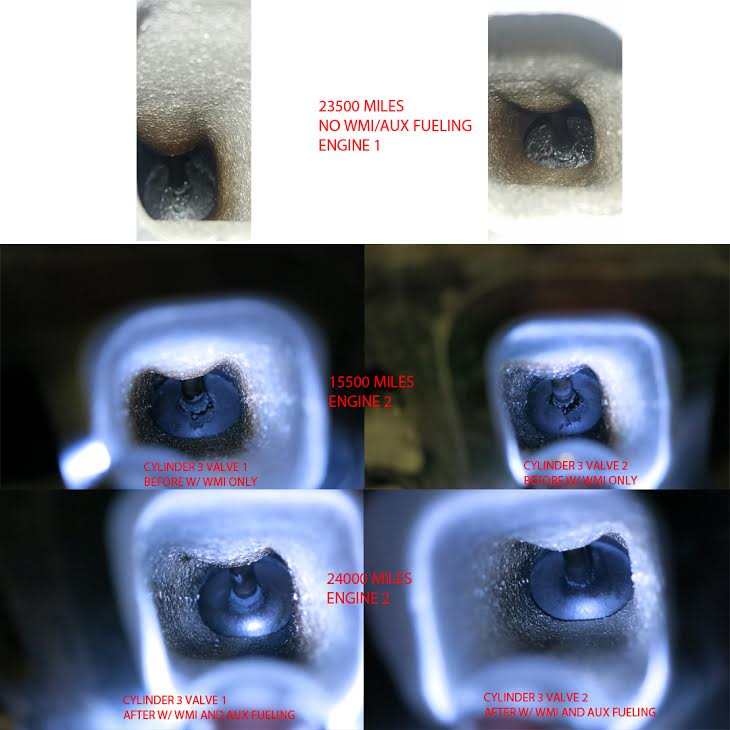
One drawback of direct injection engines is intake valve carbon buildup, since fuel no longer sprays across the intake valves as it does in traditional port injection systems.
By introducing fuel upstream of the intake ports under load, auxiliary port injection helps significantly reduce carbon accumulation on the intake valves and can greatly extend the interval between intake valve cleaning services such as walnut blasting.
Below is a comparison showing intake valve cleanliness between a pure DI setup and a DI + auxiliary port injection setup.
Features & Benefits
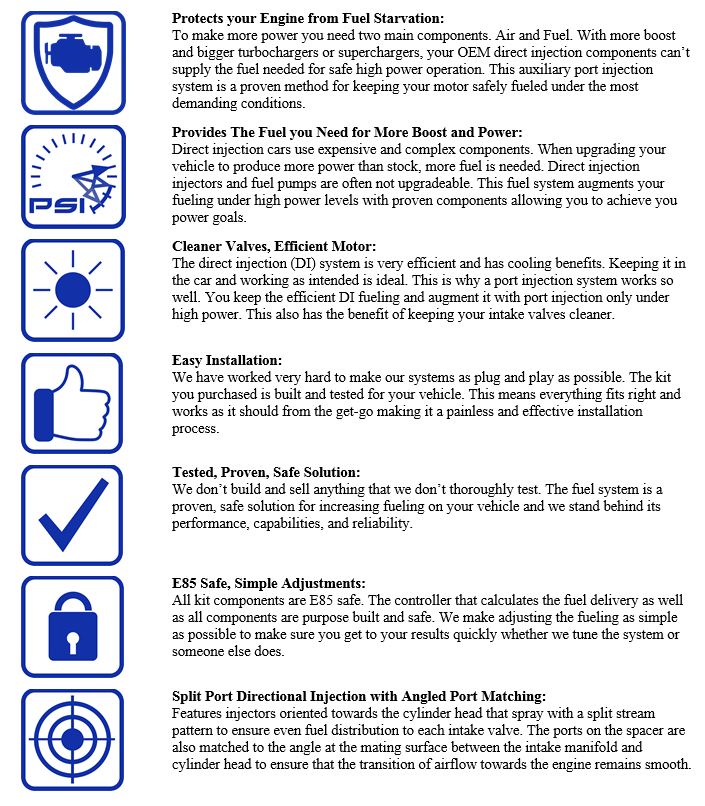
Installation of the X4tra Fuel System is straightforward and requires no cutting, splicing, or soldering of the factory wiring harness. Unlike water-methanol injection systems, there are no additional tanks, reservoirs, or external pressure regulators required.
Once installed, the system must be properly calibrated to work seamlessly alongside the OEM direct injection system. Proper tuning ensures accurate fuel delivery, OEM-like drivability, and reliable power output — particularly when running ethanol blends, which require substantially higher fuel flow capacity.
Turn-around time: Up to 15 business days

